Choosing the best China Positioning Spot Welding Machine requires more than comparing price, power, or delivery time. It requires evidence from the production floor.
The International Federation of Robotics reported 541,302 industrial robots installed worldwide in 2023. China represented more than half of those installations. This trend reflects stronger automation demand, especially in automotive, battery, appliance, and metal-component manufacturing. A welding machine must therefore fit the entire workstation, not operate as an isolated purchase.
Taiichi Ohno, the influential Toyota production expert, said, “Without standards, there can be no improvement.” His principle applies directly here. Buyers should examine electrode alignment, positioning repeatability, weld-current stability, cooling performance, and controller data records. These details become visible beside a real production line. Look for stable clamping, clean weld nuggets, and consistent cycle times.
The China Welding Equipment Industry Association emphasizes process control, equipment reliability, and intelligent manufacturing development in its industry publications. Meanwhile, ISO 5821 and related resistance-welding standards provide useful guidance for electrode dimensions and welding practice. However, supplier brochures often show ideal conditions. That is not enough.
Ask for sample welds using your actual steel, coating, thickness, and fixture design. Request destructive test results, maintenance records, and software demonstrations. Inspect the copper arms closely. Small alignment errors can become expensive quality problems.
The best choice may not be the cheapest machine. It may be the one with clearer data, faster service, and stronger process discipline. Even this approach has limits. A perfect specification cannot replace skilled commissioning and disciplined daily inspection.
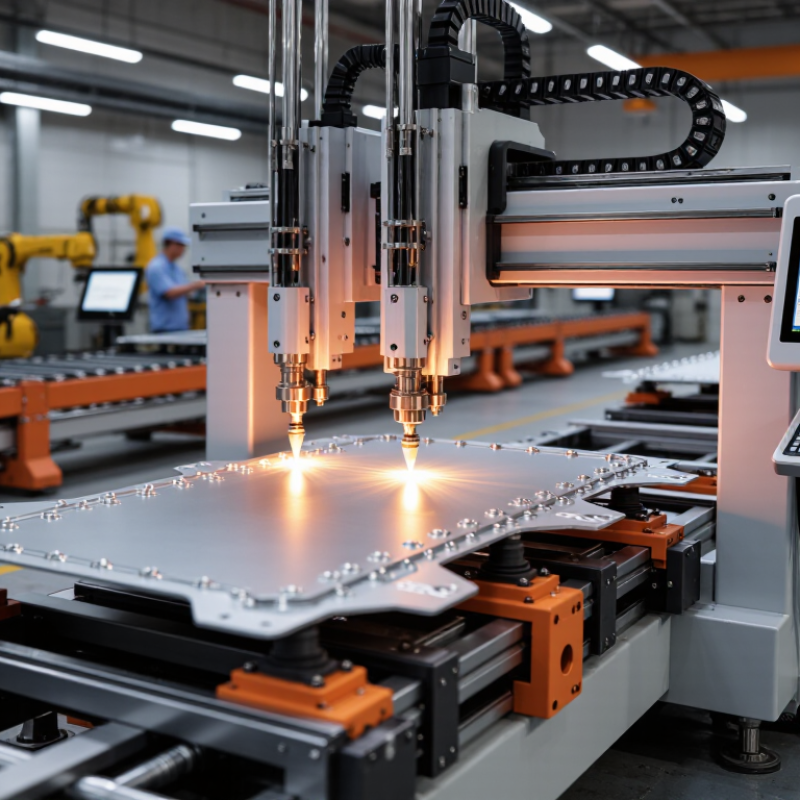
Choosing China’s best positioning spot welding machine starts with defining your exact welding requirements. Do not begin with maximum power. Record the material type, thickness range, coating, joint design, and required weld diameter. Then inspect the workpiece itself. A narrow automotive bracket may need a compact electrode path. A large cabinet panel may require stable positioning across a wider area. Measure access angles, clamping points, and distortion risks before requesting quotations.
Your production goal should be equally specific. State daily output, takt time, operator skill, floor space, and acceptable rework rate. If the target is 600 assemblies per shift, calculate loading, welding, inspection, and unloading time. A machine that welds quickly but needs frequent manual alignment may miss the real target. Ask for repeatability data using your actual materials, not only empty-machine demonstrations. Request sample welds, electrode-life estimates, current monitoring, and failed-test records. These details reveal practical reliability.
Positioning accuracy matters when holes, seams, or multiple weld points must align. Check fixture changeover time and whether the controls can store approved welding parameters. Include electrical capacity, cooling needs, guarding, and maintenance access in the site plan. A useful specification leaves room for variation. Material coatings change. Operators also make mistakes. Your first requirement sheet may be incomplete, and that is normal. Review it after a pilot run, especially if weld marks, electrode wear, or cycle delays differ from expectations.
Choosing China’s best positioning spot welding machine requires comparing control, repeatability, and serviceability. A practical machine should hold panels firmly before current flows. Check fixture rigidity, electrode alignment, welding force, and programmable current profiles. These details affect nugget consistency more than impressive power ratings.
Medium-frequency inverter control often offers faster response and lower transformer weight. Ask for current accuracy, force feedback, cooling capacity, and cycle-time records. Vision positioning can reduce setup errors, especially with changing workpieces. However, cameras need clean lenses and stable lighting. I have seen sophisticated systems underperform because operators ignored calibration. That weakness matters.
Automation also deserves careful comparison. The International Federation of Robotics reported 276,288 industrial robots installed in China during 2023, representing 51% of global installations. This growth supports better integration between fixtures, robots, and welding controllers. Review communication protocols, emergency circuits, guarding, and maintenance access against IEC 62135-1 requirements. For structural applications, verify process documentation under ISO 4063 and electrode dimensions under ISO 5821. World Steel Association data recorded about 1.89 billion tonnes of crude steel production worldwide in 2023, showing the scale of demanding fabrication environments. Yet higher automation is not always better. A simpler servo fixture may deliver more reliable positioning when operators need quick adjustments. Request sample weld records, destructive test results, spare-part lead times, and training details before purchase. Cost alone is a poor comparison.
The chart compares typical performance ranges for positioning spot welding machines used in sheet-metal and component assembly. Higher positioning accuracy, welding current, electrode force, and production capacity can improve weld consistency, while shorter cycle time increases throughput. Select a machine according to material thickness, joint accessibility, automation level, and required repeatability.
Choosing China’s best positioning spot welding machine requires more than comparing price tags. Start by checking frame rigidity, electrode alignment, transformer insulation, and weld-head movement. A stable frame reduces vibration when thin cells or metal tabs are positioned repeatedly. Ask for material certificates, inspection records, and a sample weld made with your components. The sample matters most. Inspect nugget size, surface marks, pull strength, and heat spread under magnification. An attractive cabinet proves little.
Safety evaluation should cover electrical protection, emergency stopping, guarding, grounding, and heat management. The operator should reach controls easily without placing hands near moving electrodes. Check whether the machine detects overcurrent, abnormal temperature, weak air pressure, and electrode wear. Clear alarms are essential. Ask for risk assessments, wiring diagrams, maintenance intervals, and operator training materials. Do not accept vague compliance promises; request test evidence for the intended market. Some suppliers may provide polished documents but limited practical training. That gap deserves attention.
Technical performance depends on positioning accuracy, welding current stability, pulse control, cycle time, and repeatability. Run at least three production trials, including a cold start and a long continuous cycle. Record current, pressure, weld time, reject rate, and electrode temperature. Small variations can become expensive defects. Confirm software access, recipe protection, data export, spare-part availability, and technical support response. I would also test awkward parts, not only perfect samples. Real production is rarely perfect. A machine that performs well only in demonstrations may still require costly adjustment after installation.
Choosing China’s best positioning spot welding machine starts with verifying the manufacturer, not comparing catalog prices. Request a valid business license, ISO 9001 certificate, welding procedure records, and recent customer references. The ISO Survey 2022 recorded more than 1.2 million ISO 9001 certificates worldwide, so certification matters, but it does not prove machine quality alone. Ask for serial-number traceability, electrical test reports, and a live factory inspection.
Customization should match your production reality. Provide sample parts, sheet thickness, electrode material, weld schedule, and required cycle time. A credible engineering team should conduct repeatability tests and show current, pressure, and weld-time curves. The International Federation of Robotics reported 541,302 industrial robots installed globally in 2023. This growth increases the need for reliable machine interfaces, especially when a spot welder must connect with fixtures, sensors, or robotic cells. Still, I would not accept a polished demonstration as final evidence. One clean weld proves little.
After-sales support is often overlooked. Confirm response times, spare-parts availability, remote diagnostics, and technician coverage before payment. Request a written warranty with clear exclusions and training responsibilities. Check whether the supplier stocks transformers, electrodes, controllers, and cooling components locally. During factory acceptance testing, run repeated welds after the machine warms up. Weak support usually appears later. My own checklist would also include noise, coolant leakage, cable heating, and operator access. It is easy to miss small details. Insist on documented acceptance criteria, even when the supplier seems trustworthy.
| Evaluation Dimension | Suggested Weight | Practical Benchmark | Documents, Tests, or Questions to Verify | Risk Signals Requiring Further Review |
|---|---|---|---|---|
| Legal Manufacturer Credentials | 10% | The supplier should provide its registered legal entity name, business address, manufacturing address, and authorized contact details. | Check the business registration information through the relevant official Chinese government business-registration system. Confirm that the legal entity on the quotation, contract, invoice, and export documents is consistent. | The seller refuses to disclose the manufacturing entity, uses different legal entities during the purchasing process, or cannot provide a verifiable factory address. |
| Quality Management System | 8% | A valid ISO 9001 certificate covering the relevant manufacturing activities is a useful baseline for production and document control. | Request the certificate number, scope, issuing certification body, validity dates, and audit status. Verify the certificate directly with the certification body or its public certificate database. | The certificate is expired, the scope does not cover machinery manufacturing, the certificate holder differs from the seller, or only an unverifiable scanned copy is provided. |
| Electrical and Safety Compliance | 10% | The machine should be designed and documented for the destination market. Resistance welding equipment is commonly assessed against applicable safety requirements such as IEC 62135-1, together with local electrical and machinery regulations. | Identify the destination-market requirements before ordering. Request a declaration of conformity, electrical schematic, protective-earth test record, insulation test record, emergency-stop test, and applicable type-test reports. | A generic CE logo is shown without a declaration of conformity, technical file, risk assessment, or test evidence. Required voltage, frequency, enclosure, or safety functions are unclear. |
| Machine Capacity and Duty Cycle | 12% | Compare rated welding current, welding transformer capacity, electrode force, throat depth, weld time range, cooling method, and duty cycle with the actual workpiece and production cycle. | Require a complete specification sheet with units and test conditions. Confirm whether current is stated as RMS or peak, whether force is pneumatic or servo-controlled, and whether the rating applies continuously or intermittently. | Only a maximum current is advertised, with no duty cycle, force range, cooling requirement, weld-time resolution, or operating conditions. |
| Positioning Accuracy and Repeatability | 12% | The supplier should state positioning accuracy and repeatability using a defined measurement method. The required value must be based on the electrode geometry, part tolerance, and process capability. | Request a factory acceptance test using the buyer's workpiece or a representative fixture. Record electrode position, fixture datum, weld location, sample size, and measurement instrument. A sample size of at least 30 consecutive parts gives a more useful repeatability check than a single demonstration. | “High precision” is claimed without a numerical tolerance, measurement method, sample data, or explanation of how fixture and part variation are controlled. |
| Weld-Process Control | 12% | The controller should allow controlled adjustment of welding current, weld time, squeeze time, hold time, and electrode force. Monitoring of current, voltage, force, or displacement is preferable for quality-sensitive production. | Request a controller parameter list, user-interface screenshots, recipe-management details, alarm history, data-export options, password levels, and communication interfaces such as Ethernet or fieldbus where required. | Parameters are adjusted only by the supplier, recipes cannot be locked or saved, process data cannot be exported, or alarms do not identify the affected parameter. |
| Customization and Fixture Integration | 12% | Customization should cover electrode shape, fixture design, pneumatic or servo actuation, sensors, guarding, loading method, software logic, and integration with upstream or downstream equipment. | Provide drawings, material specifications, sample parts, takt time, weld-point coordinates, utility requirements, and interface signals. Obtain an approved layout, electrical schematic, pneumatic diagram, bill of materials, and change-control procedure. | The supplier proposes a standard machine without reviewing part drawings, weld-point access, electrode clearance, fixture datum, cycle time, or production-line interfaces. |
| Sample Welding and Process Validation | 10% | The machine should be validated with production-grade materials, thicknesses, coatings, electrode tips, and fixture conditions rather than only demonstration coupons. | Define acceptance criteria in advance, such as visual appearance, nugget size, pull-test or peel-test result, indentation limit, splash control, cycle time, and dimensional repeatability. Keep signed test records and photographs. | Testing uses different material, thickness, surface condition, or electrode geometry from the real application, or the supplier refuses destructive testing where it is technically appropriate. |
| Factory Acceptance Test (FAT) | 8% | FAT should be completed before shipment against a written checklist covering safety, mechanical functions, electrical functions, process parameters, cycle time, and output quality. | Include the approved FAT protocol in the purchase contract. Require serial-number records, calibration status of measuring equipment, test results, punch-list closure, and buyer approval before final shipment. | The supplier considers a video or an internal visual inspection sufficient, or refuses to link final payment to documented acceptance results. |
| Warranty and Spare Parts | 8% | The contract should define the warranty period, coverage, exclusions, response process, replacement-part availability, and responsibility for shipping and labor. | Request a written warranty certificate, recommended spare-parts list, part numbers, prices, lead times, maintenance schedule, consumable specifications, and expected availability period for critical components. | Warranty terms are only verbal, consumable parts have no identification numbers, critical components are proprietary without alternatives, or lead times are not stated. |
| After-Sales Technical Support | 8% | Support should include installation guidance, commissioning, operator training, troubleshooting, software backup, remote assistance, and an escalation contact. | Confirm support channels, service hours, language capability, remote-diagnostic method, engineer response target, onsite-service rates, training content, and availability of manuals, wiring diagrams, and maintenance instructions. | No named service contact is provided, support depends solely on a salesperson, manuals are incomplete, or the supplier cannot describe how faults will be diagnosed remotely. |
| Total Cost of Ownership | 10% | Evaluate purchase price together with tooling, transformer or controller options, cooling equipment, freight, installation, training, electricity, electrodes, maintenance, spare parts, and downtime risk. | Request a detailed quotation with Incoterms, tax treatment, packaging, commissioning scope, utility consumption, consumable prices, maintenance intervals, and estimated replacement-part costs. | A low initial price excludes essential tooling, cooling, guarding, software functions, commissioning, spare parts, or destination-market compliance work. |
Choosing China’s best positioning spot welding machine requires more than comparing quoted prices.
In daily factory use, total cost often hides in electrodes, cooling water, compressed air, and setup labor. Ask for a complete cost sheet. A low purchase price can become expensive. Check transformer capacity, control accuracy, electrode life, and maintenance intervals.
Request test data using your actual metal thickness and joint design. A sample weld is more useful than a polished catalog photograph.
Delivery terms deserve equal attention. Confirm production lead time, inspection points, packing method, spare-part lists, and responsibility for transit damage.
Clarify whether installation guidance, operator training, and remote troubleshooting are included. Put every promise in the contract.
Vague terms cause delays. Also, verify shipping documents and installation requirements before making the final payment.
Long-term value depends on stable positioning accuracy, service response, and upgrade options. A machine that repeats the same weld reduces rework and protects production schedules.
Calculate five-year costs, including downtime and rejected parts. Estimates are never perfect. Dust, voltage changes, and inexperienced operators can weaken optimistic forecasts. Leave a realistic reserve.
Choose a supplier that shares test records, defines measurable acceptance criteria, and answers difficult questions directly. Performance must remain verifiable after delivery.
Check fixture rigidity, electrode alignment, welding force, and programmable current control. The panel must stay still. These details affect weld consistency more than high power ratings.
Stable current helps produce consistent weld nuggets across repeated cycles. Ask for current curves, pressure data, and weld-time records. Small variations can create weak joints. I would not trust a power rating alone.
Vision systems can reduce setup errors when workpieces change frequently. They need clean lenses and stable lighting. Operators must calibrate cameras regularly. Fancy equipment can still underperform.
Review communication interfaces, emergency circuits, guarding, and maintenance access. Confirm compatibility with fixtures, sensors, and robotic cells. A simpler servo fixture may be easier to adjust. More automation is not always better.
Request business registration, quality certificates, welding records, and recent customer references. Check serial-number traceability and electrical test reports. A live factory inspection adds useful evidence. Certificates alone prove little.
Provide sample parts, sheet thickness, electrode material, and required cycle time. Ask the supplier to test your actual joint design. Review current, pressure, and weld-time curves. One clean weld proves little.
Confirm response times, spare-part availability, remote diagnostics, and technician coverage. Check access to transformers, electrodes, controllers, and cooling components. Request written warranty exclusions and training responsibilities. Weak support appears later.
Include electrodes, cooling water, compressed air, setup labor, maintenance, and downtime. Compare five-year costs, not only purchase prices. Request test data using your metal thickness. Estimates can be wrong.
Run repeated welds after the machine reaches operating temperature. Inspect coolant leakage, cable heating, noise, and operator access. Record measurable acceptance criteria. Do not rely on demonstrations alone.
Confirm production time, inspection points, packing, spare parts, and transit responsibilities. Clarify installation guidance, training, and remote troubleshooting. Put every promise in the contract. Vague terms cause delays.
Choosing the right Positioning Spot Welding Machine begins with clearly defining your welding requirements, production volume, material types, workpiece sizes, and quality targets. Consider whether the machine can provide accurate positioning, stable welding current, adjustable parameters, suitable electrode movement, and compatibility with your existing production process. Comparing automation level, control systems, welding speed, energy efficiency, maintenance needs, and operator convenience will help identify the most suitable configuration. Quality construction, reliable safety protection, consistent technical performance, and compliance with applicable standards are also essential for dependable operation.
Before making a decision, verify the manufacturer’s production experience, quality control procedures, customization capabilities, installation guidance, training, spare-parts availability, and after-sales response. A complete evaluation should also include the total purchase cost, transportation, installation, delivery schedule, warranty conditions, and expected maintenance expenses. The best choice is not always the lowest-priced machine, but the one that delivers stable performance, safe operation, flexible production, and long-term value while supporting your efficiency and business growth.

Wentong Machinery